Self-Defense for the Mature American
By Attorney Joey Hamby
May 1, 2026
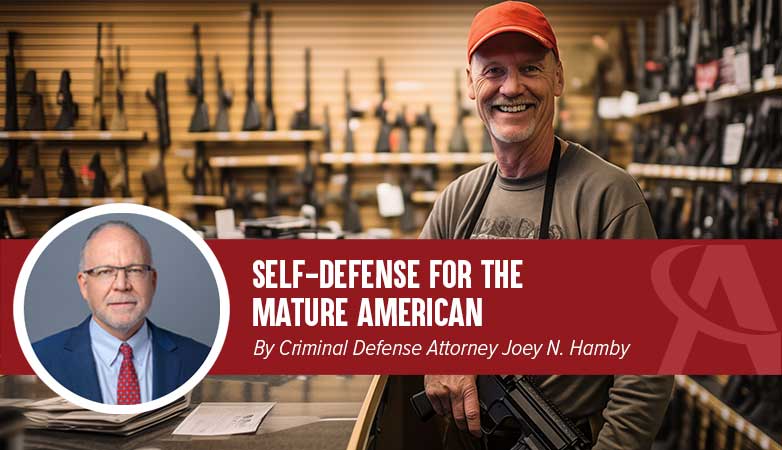
As we age, we increasingly become targets for predators. Our physical presentation, including posture, gait, and visible infirmities, often signals to criminals that we are less able to fend off an attack. For the mature citizen, making proactive decisions about protection is no longer just an option; it is a necessity for maintaining safety and independence.
The Best Way to Win
The most successful self-defense encounter is the one that never happens. Many of us walk through the day disconnected or unfocused, expecting that we are safe. We fail to use the best tools we have to avoid being victimized: our physical senses and our intuition. When you sense that something isn’t right, pay attention to that feeling and act on it. If you are not paying attention to what is happening around you, your intuition will never kick in.
As we age, our hearing and vision are affected, and we may well miss cues. We are also becoming increasingly distracted by our phones and electronic devices. People, young and old, are wearing noise-cancelling headphones and ear buds, playing games on their phones, checking social media, and blinding themselves to the world around them. These are clear indicators to a criminal that you are an easy target. As we age, we must take extra steps to compensate for our declining senses with heightened situational awareness.
We need to stay focused on our immediate environment, project confidence with our body language, and trust our instincts. While it may be very inconvenient to walk away from a situation just because it feels a little off, that action may save tremendous amounts of grief later on.
The Right Tools for the Job
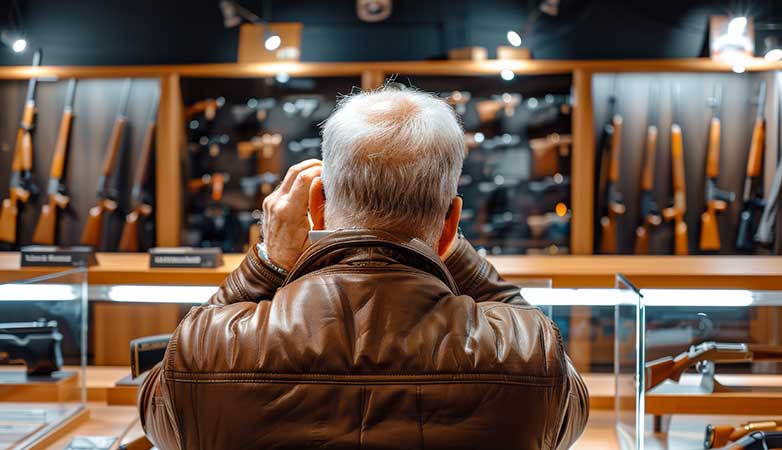
If you have decided to own and carry a firearm for self-defense, your choice of equipment must evolve with your physical capabilities. Factors like fading vision, arthritis, and reduced grip strength can be managed with different tools. Every person is different, with their own limitations and preferences. One of the great things about our self-defense communities and suppliers is that there are solutions for almost every issue that we deal with. This can include using a revolver instead of a semi-auto or transitioning to an easier-to-rack semi-auto. It can also include compensators, high-visibility sights, optics, lasers, lights, and other systems to overcome almost any hurdle.
Practical Carry and Training
How you carry your defense tool is just as important as what you carry. Traditional inside-the-waistband (IWB) holsters may cause discomfort for those with back or hip pain. Different types of holsters or carry accessories, such as specialized concealed carry bags, purses, or fanny packs may be appropriate.
However, to get the most out of these tools you will need training and practice. Ideally, this will mean taking classes and working with self-defense instructors. Train with your physical limitations and train for real-world situations. Learning how to shoot at paper targets in a well-lit range with no stress is not helpful in a dark parking lot with your hands full and a potential threat running at you.

Legal Considerations
I have represented thousands of clients, all with varying levels of physical, psychological, and cognitive capabilities, and there is no single solution to every situation. This is why we constantly tell our clients that they should not try to deal with the aftermath of a self-defense incident on their own. In my experience, the vast majority of times, the person attacking you will lie about the facts. Very few people will admit that they attacked you, forcing you to defend yourself.
The initial contact with law enforcement can determine whether you will be rightly viewed as the innocent victim or arrested and charged with a crime. You have probably never dealt with an officer questioning you as a potential criminal. However, as criminal defense attorneys, we have done this many times. We have been on the phone with our clients when police show up to a scene of a defensive display or even a fatal shooting. We have kept our clients from being arrested and charged. Even if they have been arrested, we have made sure that they invoked their rights, and then we have taken steps to get them out of custody at the first possible moment.
There are many tools that investigators use to obtain information, including video recordings, cell-phone extractions, computer analysis, and other tools. But one of the oldest, and most heavily utilized, is still the in-person interview, or interrogation. If an officer extracts a confession, or words that can be used as a confession, the case may well be over. Your verbal and non-verbal responses can and will be used against you. I have seen cases where my client could not hear, or misunderstood a question, and where the response was viewed as an incriminating statement. I have also had clients whose age, infirmities, or medication, could lead an investigator to believe that they were being deceptive. Think of the various issues you may be dealing with and then add the stress of being in a life-or-death incident. How confident are you that you can deal with all of that and then give a calm, reasonable, legally appropriate explanation for your actions?
Hopefully just thinking of this possibility will convince you that you should not try to handle this life-changing legal event on your own. Part of being prepared for a self-defense event includes dealing with the aftermath and having counsel on board, ready to take your call in the middle of the night.
Generally, the law doesn’t change based on the age of the individuals involved. However, the legal standards do take factors like age and capability into consideration. The legal touchstone for self-defense is the reasonableness of the use of force. That includes the critical concepts of Necessity, Imminence, and Proportionality.
Age and physical capability can impact each of those factors. It is fairly easy to see how an elderly person with physical infirmities can be viewed in a much different light when it comes to the Necessity of the use of force, the Imminence of a threat, and the Proportionality of the response.
The same age and physical issues that can make an elderly person a target should also be taken into consideration when addressing these critical legal factors. This is not a license to use deadly force just because a person is elderly or infirm, but it is something that has to be considered as part of self-defense.
Ultimately, self-defense for the mature citizen is about empowerment. By staying alert and choosing tools that align with your physical abilities, you can maintain your independence and safety for many years.
About the Author
Criminal Defense Attorney Joey N. Hamby

Joey Hamby is a senior criminal defense attorney, a certified specialist in criminal law, and an author on The Attorneys On Retainer blogs. With decades of experience in self-defense cases, he is dedicated to protecting the rights and freedoms of responsible gun owners.
All Posts by Joey N. Hamby | Joey N. Hamby's Full BioHave a Question About AOR Membership?
Our team is ready to walk you through your options. Fill out the form and we’ll be in touch shortly.