

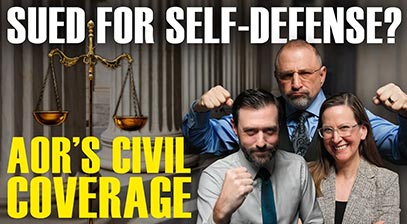
You Won the Criminal Case. Now They’re Suing You.
Most people think a self-defense incident ends with an acquittal. It doesn’t. The civil lawsuit is the third battle — and until now, it was the one AOR members faced without in-house counsel. That changes with Susan Euteneuer.
Read More
AOR Covers What Other Traditional Insurance-Backed Programs Won’t
Traditional self-defense insurance programs are built around fine print designed to protect the company, not you, with exclusions for things like expired permits, gun-free zones, and impairment that can leave you without representation the moment you need it most. Because AOR is backed by a law firm and not an insurance company, there are no hidden exclusions — if you claim self-defense and meet our three criteria, we cover what other programs won't.
Read More
AOR Covers You Even if You Are a Prohibited Possessor
Many traditional self-defense programs will reject claims from individuals classified as prohibited possessors. Even if your use of force was justified, your status as a prohibited possessor at the time of the incident may prevent your defense from being covered.
Read More
AOR Covers You Even if You are Charged With a Crime
If you ever find yourself in a situation where you need to defend yourself, it is essential to understand that you may face criminal charges, especially in politically sensitive or high-profile cases. Prosecutors often assume the worst and tend to file charges before thoroughly investigating the situation. Even if you were the one attacked, the legal system might still perceive you as the aggressor.
Read More
AOR Covers You Even if You Are in a Less-Friendly Gun State
You have the right to defend your life wherever you are in the United States. However, if you are forced to act in self-defense in a state with strict firearm laws, you might find yourself not only fighting for your freedom but also lacking essential support when you need it most.
Read More
AOR Covers You Even If You Have a CCW Permit That Is Invalid, Expired, or Nonexistent
If your CCW permit is expired, invalid under local laws, or nonexistent, traditional self-defense insurance programs may use this as a reason to deny coverage, even if your use of force was lawful and justified.
Read More
AOR Covers You Even if You Used an Illegal Weapon in Self-Defense
When you're being attacked, you grab whatever is within reach, and the law doesn't always care what that is. Most self-defense insurance programs will drop you the moment an illegal weapon is involved, but AOR will still represent you as long as you meet our three coverage criteria.
Read More
AOR Covers You Even if You Were Impaired by Alcohol or Drugs
Studies show that nearly two-thirds of violence-related injuries involve alcohol use by the victim, the attacker, or both, which means self-defense situations don't wait for you to be sober. Unlike traditional insurance-backed programs that deny coverage the moment impairment enters the picture, AOR evaluates whether you reasonably acted in self-defense, not what was in your system.
Read More
AOR Covers You Even if Your Incident Involved a Negligent Discharge
A single unintentional shot during a life-or-death struggle should not cost you your legal representation, but for most insurance-backed self-defense programs, it does. AOR doesn't deny coverage because a discharge gets labeled "negligent" — if you claimed self-defense and meet our three criteria, we will be in your corner.
Read More
AOR Covers You Even if Your Incident is Classified as a Domestic Dispute
Not every threat comes from a stranger, and your right to defend yourself does not disappear because the attacker is someone you know. Most traditional self-defense insurance programs exclude domestic disputes entirely, but AOR will represent you regardless of your relationship to the person who threatened you.
Read More