
Understanding the Castle Doctrine: Protecting Your Family and Defending Your Home
By. Attorney Emma K. Wittmann
December 18, 2025
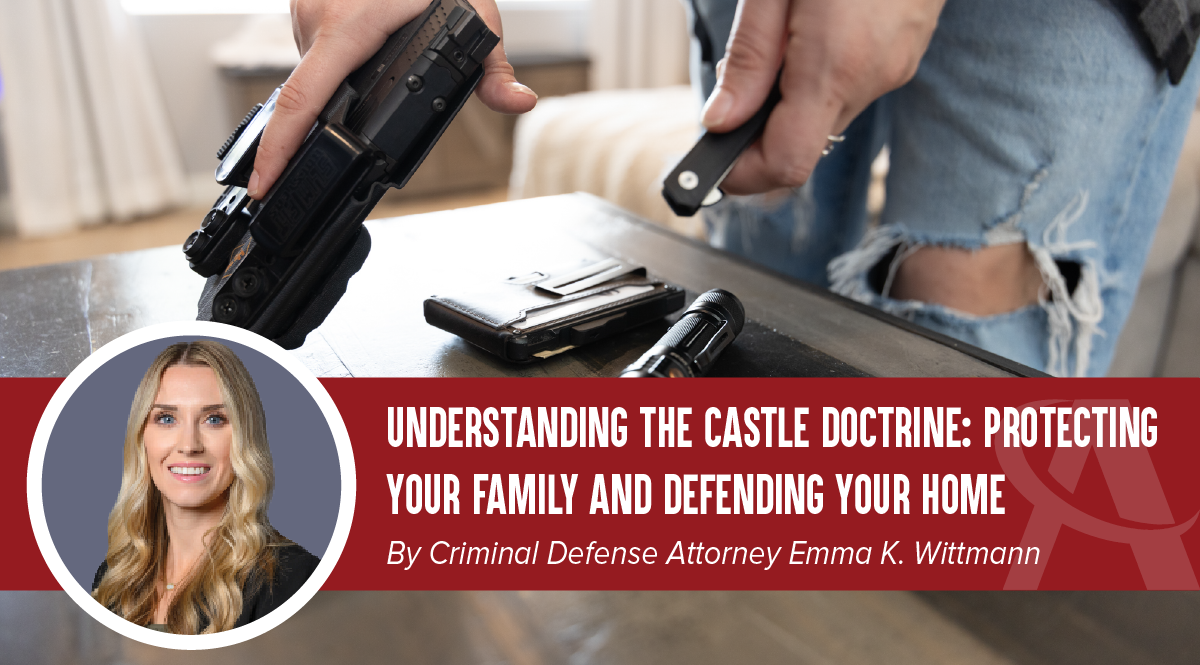
It is late at night, and you are startled awake by a crashing sound in your home. You quickly unlock your safe and grab your firearm. You are about to exit your bedroom to face the intruder, and your mind is racing thinking, “How am I going to respond if there is someone in my home?” When you do act on a break-in, your immediate afterthought could be, “Was I legally allowed to do what I did?” Let’s break down some crucial self-defense principles and equip you with the legal tools you need to act lawfully to defend your loved ones inside your home.
What is Castle Doctrine?
Few legal principles capture the intersection of personal safety, property rights, and criminal liability as vividly as the Castle Doctrine. Rooted in the age-old adage that “a man’s home is his castle,” this doctrine governs when a person may lawfully use force—sometimes deadly force—to defend themselves within their home or other protected spaces. This early articulation established that an individual should not be forced to retreat from an intruder within their dwelling, a principle that later became the foundation of American self-defense law.
While the Castle Doctrine may seem straightforward in principle, its application varies dramatically across jurisdictions and often raises nuanced questions of reasonableness, necessity, and proportionality.
At its core, the Castle Doctrine provides that a person who is lawfully present in their dwelling has no duty to retreat before using reasonable—even deadly—force against an intruder who unlawfully enters or attempts to enter. The Castle Doctrine does not grant a blanket license to use lethal force, however. The Castle Doctrine requires the individual using self-defense to reasonably believe that the intruder poses an imminent threat of death, serious bodily injury, or the commission of a forcible felony. The defender must determine that the deadly physical force was necessary to prevent imminent harm or death to themselves or another person and respond proportionally.
What are Some Important Differences in Castle Doctrine Laws?
Castle Doctrine is one concept that all fifty states agree on – to an extent. There are subtle differences in Castle Doctrine laws throughout the United States, which can dramatically affect whether you are charged with a crime.
What are some of these differences? Some states have a Castle Doctrine that only covers your home. Other states’ Castle Doctrine provides protection in additional places, like vehicles.
There are also differences in when the individual can initiate deadly physical force. Some states require the intruder to be inside your home before the use of force is considered justified under the Castle Doctrine. For example, in Colorado, the intruder cannot be on your back porch; the intruder must already be inside the home before the use of force is justified. In other states, individuals do not need to wait until the intruder is inside the home to employ deadly physical force. In some states, the attempted intrusion into the house is enough. Arizona and Missouri are examples of this type of Castle Doctrine.
Let us dive into a hypothetical to illustrate the differences. You are a homeowner in the state of Arizona. You find yourself home alone. You go to bed as you normally do, and you are woken up by your dog barking. You go out to your living room, and you see a man attempting to break in. You threaten deadly physical force against him, and he continues attempting to break in. You feel that you are in imminent danger of grave physical injury or death. You decide to deploy your firearm, and it strikes the attempting intruder. Now, let us change one fact: you are a homeowner in Colorado, and not in Arizona. The analysis of when you can use deadly physical force against the intruder changes completely. You are much more likely to be successful in a claim that your conduct falls under the Castle Doctrine in Arizona than in Colorado.
There are additional considerations that factor into the scope and strength of the protection. There are automatic presumption states. This means there is a presumption that an occupant reasonably fears death or serious harm when an intruder unlawfully enters the home. This then shifts the burden to the prosecution to rebut the presumption, providing strong protection for defendants who act in self-defense within their home. Some states have a qualified or conditional presumption, where the presumption is limited to situations involving forcible and unlawful entry, or where the defender knew of the entry. These laws aim to guard against defenses in situations where the intruder may have had lawful access to the residence or did not pose a threat. Lastly, there are Duty to Retreat jurisdictions, where the defender has a limited duty to retreat if a safe escape is possible.
What Does Castle Doctrine NOT Cover?
Castle Doctrine does not protect physical property; it protects people. As a rule, individuals are not allowed to use deadly physical force to protect just personal property.
Crime Prevention Statutes
Some states have crime prevention statutes that say a person is justified in threatening or using physical or deadly physical force against another if they reasonably believe it is immediately necessary to prevent another from committing a specific criminal offense. This may include preventing arson of an occupied structure or burglary. Burglary is when someone enters a property or residential structure unlawfully with the intent to commit a felony therein.
If you are in a state that has a crime prevention statute, then you can use physical force to prevent the commission of a burglary of your home.
Practical Takeaways for Homeowners
The Castle Doctrine stands as a powerful expression of the law’s respect for personal security and the sanctity of the home. The key takeaway is that the Castle Doctrine provides powerful legal protection, but it is not absolute. The strength of your self-defense claim still needs the key components of reasonableness, imminency, and proportionality.
Castle Doctrine does not provide a blanket authorization for using deadly physical force in every scenario involving a perceived risk. Remember, the Castle Doctrine is a defense and not a preclusion of prosecution. Any time you use a firearm in self-defense in this type of scenario, you should expect to be the subject of an investigation. The result of the investigation hinges on your set of facts, any statements you choose to make to the police, and your state’s laws.
Understanding the nuances of the Castle Doctrine in your state is crucial to the success of your self-defense claim in a criminal case. Look into the Castle Doctrine laws in your state to better understand what places and what conduct is legal. That way, if you ever find yourself in a position where you reasonably believe you must use physical force to defend yourself or your loved ones in your home, you are equipped with knowledge of how to act.
About the Author Criminal Defense Attorney Emma K. Wittmann

Emma K. Wittmann, a dedicated criminal defense attorney and author on The Attorneys On Retainer blogs, tirelessly defends clients in felony cases with aggression and expertise, ready to advocate for you.
View All Posts by Emma K. Wittmann | Read Emma K. Wittmann's Full Bio