Your Gun. Your Home. Whose Rules?
Do safe-storage laws actually make us safer, or do they turn decisions traditionally left to responsible gun owners into potential criminal offenses?
By Howard A. Snader, Esq.

The Gun You Trust Could Become the Gun You Have to Explain
You hear glass breaking at 2:00 a.m. Someone is inside your home. You grab your handgun, confront an intruder, and fire because you reasonably believe your life is in danger. You survive, but the intruder does not. You believe you acted in lawful self-defense. But during the investigation, police discover that your handgun has a modified trigger, a red-dot sight, and a weapon-mounted flashlight. All three modifications were intended to make your firearm easier and safer to use. Could those same modifications now be used against you?
A prosecutor may certainly think so!
When Safety Becomes the Prosecutor’s Argument

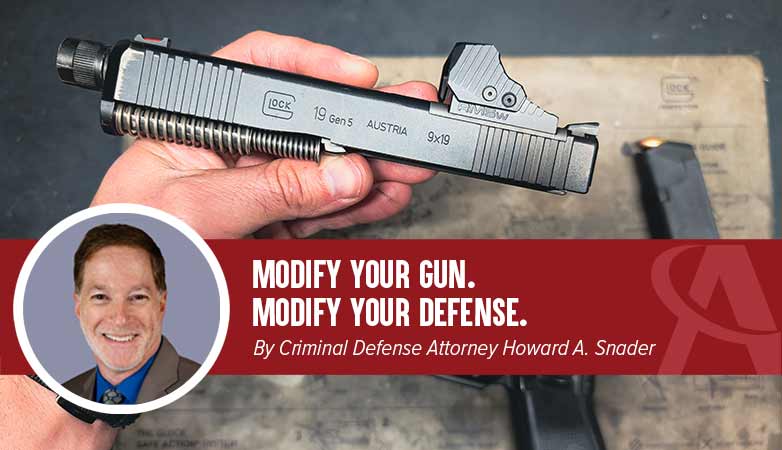
Gun owners modify their firearms for many legitimate reasons. Some want better accuracy. Others want faster target acquisition, improved visibility, or a more comfortable trigger. These are reasonable objectives. After all, if you must defend yourself, wouldn’t you want every possible advantage? But consider how a prosecutor might characterize those same modifications.
You say your modifications help you shoot more accurately. A prosecutor might suggest you designed your firearm to make shooting someone easier. You say your modifications help you fire more quickly. A prosecutor might argue you were preparing to unleash more rounds than necessary. The very explanation you believe demonstrates responsibility could be portrayed as evidence of aggression. That does not mean the prosecutor’s argument is correct, or that a judge will permit it. But it illustrates why lawful modifications deserve careful consideration.
Lights On, Muzzles Up: A Dangerous Combination?
Consider a weapon-mounted flashlight. One of the basic tenets of firearm safety is the identification of your target AND what is behind your target. A weapon-mounted flashlight can certainly help you determine whether someone is armed, identify innocent bystanders, and better evaluate what lies beyond your intended target. However, there is another side to this modification.
Imagine hearing a noise outside your home. You investigate with your handgun and activate its mounted flashlight to identify someone standing near your property. The person turns out to be a teenager looking for a lost basketball. You never intended to threaten anyone. You simply wanted to see who was there.
But if you pointed the light directly at that teenager, you may also have pointed a loaded firearm at him.
Depending on the circumstances and applicable law, that conduct could raise questions about aggravated assault, threatening behavior, or improper firearm handling. A weapon-mounted light does not necessarily require pointing the muzzle directly at someone to illuminate an area. Nevertheless, it is not a substitute for an ordinary flashlight. The lesson? A modification that improves your ability to identify a threat can create a separate problem if used before a threat has been established.
Red Dots: Better Accuracy or Better Killing?
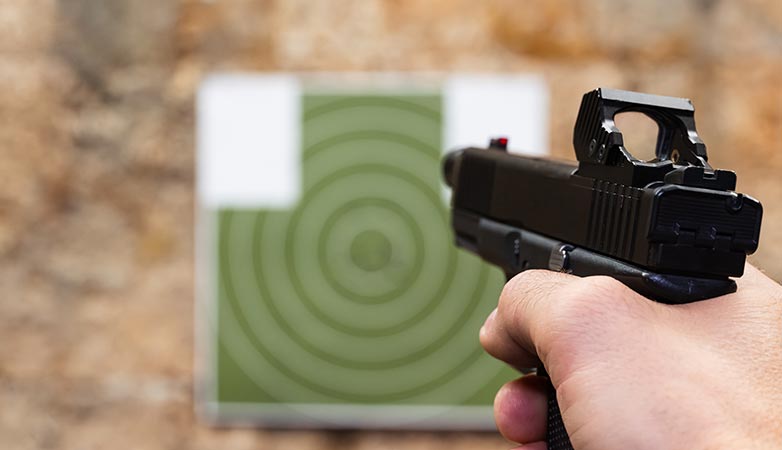
Red-dot sights are increasingly popular because they can help shooters acquire a sight picture quickly and improve accuracy. From a defensive perspective, that makes sense. If deadly force becomes necessary, you want to stop the threat without endangering innocent people. But imagine explaining your red-dot sight to a jury.
You testify that it allows you to acquire your target faster and place your shots more accurately. A prosecutor might emphasize those same words, suggesting that you deliberately equipped your firearm to shoot people faster and more effectively. That argument may be unfair. After all, accuracy can reduce the danger to bystanders.
Nevertheless, the issue illustrates an important distinction: What you intended to accomplish with a modification and how someone else characterizes that intention may be entirely different.
A Hair Trigger Could Raise Eyebrows
Trigger modifications present another concern. Some owners install lighter triggers to improve control and accuracy. Others install forced-reset triggers, commonly called FRTs, which can permit much faster firing. There are important mechanical and legal differences between these modifications. Forced-reset triggers are also subject to restrictions in certain jurisdictions.
Now imagine a defensive shooting involving multiple rounds. You explain that your modified trigger helped you fire quickly when your life was threatened. The prosecutor responds: Why did you need a firearm designed to fire faster? Were you concerned about stopping a threat, or were you preparing to fire as many rounds as possible? A lighter trigger could also become relevant if the shooting involved a disputed accidental discharge.
None of this automatically makes the modification improper. But the particular modification, its purpose, and how the firearm was used could become subjects of courtroom examination. Just because the modification is legal doesn’t mean an aggressive prosecutor will use it against you. The central issue in a self-defense case is generally whether the use of force was justified under the circumstances.
Did you reasonably believe you faced an imminent threat? Was deadly force necessary and legally justified? Those questions ordinarily matter far more than whether your firearm had factory sights or aftermarket accessories. And prosecutors cannot necessarily introduce evidence simply because it makes a defendant look dangerous. Courts apply rules concerning relevance, unfair prejudice, and admissibility.
But you need to remember that any modification may become relevant depending on the facts, particularly where intent, accidental discharge, or the manner of shooting is disputed. Before modifying your firearm, you should consider whether the modification improves safety, reliability, or control. Understand how it works, confirm that it is lawful, and obtain appropriate training. There is no “right or wrong” answer when choosing to modify your firearm. Your right to defend yourself does not disappear because you modified your firearm.
But the modifications you choose may become part of the story told about you in court. Make sure that story is one you can explain.
About the Author
Senior Criminal Defense Attorney

Howard joined Attorneys For Freedom to continue his focus on providing vigorous defense, with special emphasis on self-defense cases and protecting constitutional rights. His practice blends relentless courtroom advocacy, creative problem-solving, and disciplined case management.
All Posts by Howard A. Snader | Howard A. Snader's Full BioHave a Question About AOR Membership?
Our team is ready to walk you through your options. Fill out the form and we’ll be in touch shortly.
Related Content