
Traveling Across State Lines with Firearms: What You Need to Know
By Emma K. Wittmann, Esq.
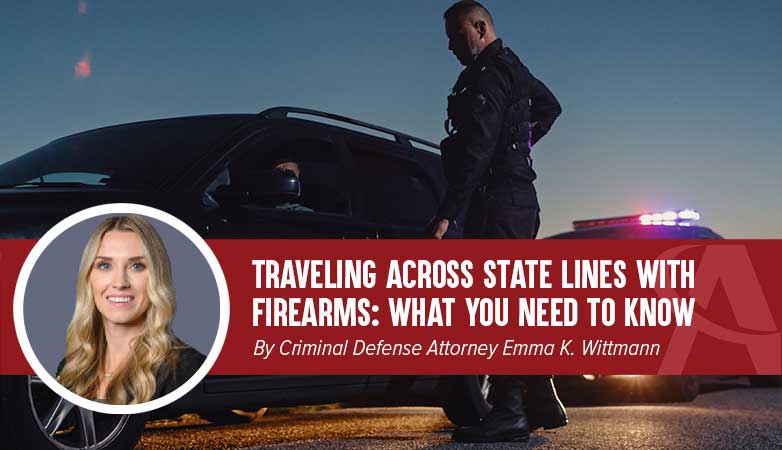
A law-abiding gun owner packs his car for a cross-country move, carefully unloading and storing his firearm the way he has done countless times before. He believes that common-sense safety rules should be enough. Days into his road trip, he is stopped during a routine traffic stop in a state he was only passing through to get to his destination. He finds himself in handcuffs and charged with a felony for unlawful possession of a firearm. He is confused as he never fired a shot, threatened anyone with it, and certainly never intended to break the law. His mistake: assuming the firearm laws travel as freely as he does.
Traveling with firearms across state lines can expose an otherwise law-abiding, responsible gun owner to serious criminal liability if they are unaware of the federal, state, and local laws that govern possession and transport. While the Second Amendment protects the right to keep and bear arms, that right is not applied uniformly across the nation. The Firearm Owners Protection Act, or FOPA, was enacted to shield responsible gun owners traveling between states, offering limited safeguards – but only if its strict conditions are met. A single misstep, an overnight stop, or access to the firearm in the wrong jurisdiction can turn a routine journey into a felony arrest, exposing how fragile those protections can be once state lines are crossed. Understanding the law in the jurisdictions you will pass through before you travel is essential.
Federal Law: The Firearm Owners Protection Act (FOPA)

At the federal level, the Firearms Owners Protection Act, or FOPA, codified at 18 U.S.C. § 926A – Interstate Transportation of Firearms, governs interstate firearm travel. FOPA provides limited protection for individuals traveling from one place where they may lawfully possess a firearm to another place where they may lawfully possess it.
18 U.S.C. § 926A – Interstate Transportation of Firearms states,
Notwithstathatg any other provision of any law or any rule or regulation of a State or any political subdivision thereof, any person who is not otherwise prohibited by this chapter from transporting, shipping, or receiving a firearm shall be entitled to transport a firearm for any lawful purpose from any place where he may lawfully possess and carry such firearm to any other place where he may lawfully possess and carry such firearm if, during such transportation the firearm is unloaded, and neither the firearm nor any ammunition being transported is readily accessible or is directly accessible from the passenger compartment of such transporting vehicle: Provided, That in the case of a vehicle without a compartment separate from the driver’s compartment the firearm or ammunition shall be contained in a locked container other than the glove compartment or console.
Under FOPA, a traveler is generally protected if all of the following requirements are met:
- The traveler is transporting the firearm for a lawful purpose.
- The traveler must be legally allowed to own, possess, and carry the firearm in their departure state and their destination state.
- The firearm is unloaded.
- The firearm is not readily accessible from the passenger compartment of the vehicle.
- The firearm is locked in a container.
- The ammunition is stored separately from the firearm and is not readily accessible.
- Your trip is continuous (i.e., not stopping for sightseeing or overnight stays).
When these measures are taken, they can provide a defense against prosecution in states with restrictive firearm laws. It is important to note that FOPA does not provide blanket immunity, however. FOPA does not override state and local laws. It simply provides a potential legal defense that may be later asserted in court.
State Laws Can Vary – Educate Yourself and Make a Plan
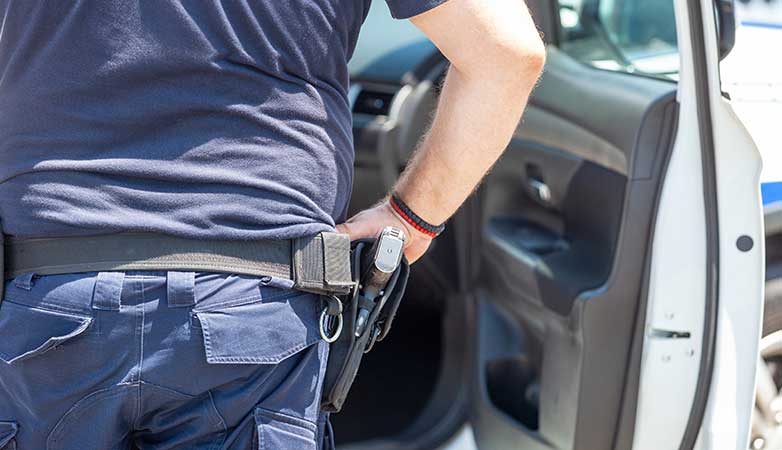
Laws governing firearm regulations can vary dramatically from state to state. While some states allow permitless carry, others impose strict licensing requirements, magazine capacity limits, ammunition restrictions, and bans on certain firearms or firearm features. A firearm that is legal in one state may be illegal just miles across the border in another state. If you violate the laws in the state you are traveling through, FOPA may not protect you. Before you begin your journey, research the laws and restrictions in the states you intend to pass through.
Simply passing through a restrictive state can create a legal risk if the traveler deviates from continuous travel (i.e., not driving straight through), stopping overnight, or accessing the firearm for self-defense or any other purpose. Deviating from continuous travel may remove the FOPA protections. Take the time to educate yourself on the laws in the states you intend to travel through. Ensure you comply with federal, state, and local laws, and make a planned route to ensure you are not stopping in restrictive states, exposing yourself to potential criminal liability.
Practical Guidance for Gun Owners Embarking on a Cross-Country Road Trip

Before traveling with your firearm, research the laws of every state you will enter, including the states you will only pass through and not stay in for any duration of time. Make sure to confirm the states that have reciprocity for any concealed carry permit, and bring your proof of your permit with you. Travelers should ensure compliance with the state and local laws on magazines, ammunition, and other firearm restrictions. Travelers should avoid unnecessary stops in restrictive jurisdictions or avoid them altogether if there is an alternate route that can be taken.
Most importantly, make sure to keep the firearms secured, unloaded, and inaccessible during transport. Failing to educate yourself on the current federal and state laws could result in felony charges, firearm forfeiture, loss of gun rights, and imprisonment.
If you are involved in a traffic stop, make sure to comply with the officer’s commands, keep your hands visible, and do not reach for anything. Only if the state law requires, inform the officer of your firearm.
Careful planning and legal awareness are the best tools for protecting your rights and your freedoms while traveling across the country.
About the Author
Criminal Defense Attorney Emma K. Wittmann

Emma K. Wittmann, a dedicated criminal defense attorney and author on The Attorneys On Retainer blogs, tirelessly defends clients in felony cases with aggression and expertise, ready to advocate for you.
All Posts by Emma K. Wittmann | Emma K. Wittmann's Full BioHave a Question About AOR Membership?
Our team is ready to walk you through your options. Fill out the form and we’ll be in touch shortly.