The Boyfriend Loophole Is Closed. Now What?
By Rachel Moss
May 29, 2026
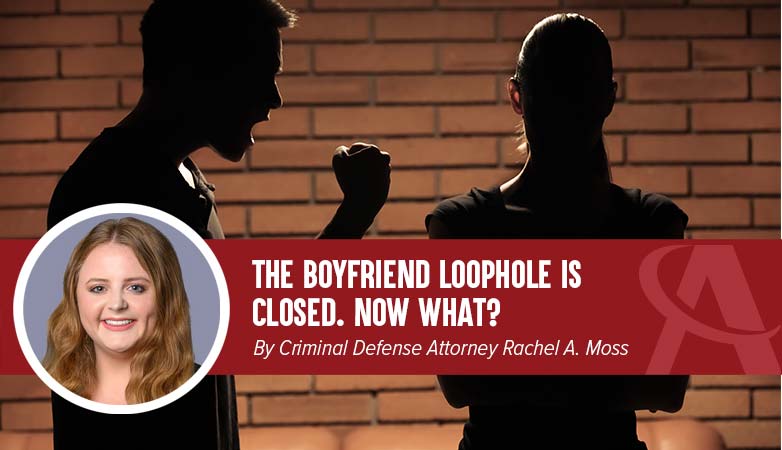
A man hits his wife. He receives a domestic violence conviction.
A woman hits her live-in partner. She receives a domestic violence conviction.
A man hits the mother of his child. He receives a domestic violence conviction.
A woman hits her boyfriend. Does she receive a domestic violence conviction? For many years, not necessarily.
Dating relationships have historically been treated differently for the purposes of restraining orders and domestic violence convictions. This eventually created a problem that became known as “the Boyfriend Loophole.”
What Is the Boyfriend Loophole?
In the 1990s, Congress amended the Gun Control Act of 1968 by adding domestic abusers subject to restraining orders and abusers convicted of misdemeanor crimes of domestic violence as categories of prohibited persons barred from buying a firearm. These two new categories operate differently, but both impact a person’s ability to legally possess a firearm.
Restraining orders do not require one’s accuser to be convicted of a crime before the order is put into place; rather, in most states, a judge must find some evidence of domestic abuse to issue a restraining order. The standard to obtain a restraining order is much lower than the burden of proof required to convict someone of a crime at trial. Therefore, restraining orders offer domestic violence victims a quicker way to receive protection from their abusers. Restraining orders often impose restrictions on the restrained party, including prohibiting contact with the protected party, as well as forbidding the restrained party from visiting the protected party’s home or workplace.
A misdemeanor crime of domestic violence, on the other hand, is a conviction. The Gun Control Act defines these crimes as offenses that involve the use or attempted use of force, or threatened use of a deadly weapon, committed by a domestic partner.
When the Gun Control Act was amended in the 1990s, domestic abusers were defined as those who were married, cohabiting, or shared a child. Notably, other romantic relationships were excluded. For example, a college freshman living in a dorm would not be considered a domestic violence victim under the Gun Control Act if her off-campus boyfriend assaulted her.
Critics of the Act argued the law failed to reflect modern relationships. Many domestic violence victims are abused by dating partners rather than spouses. As the Act stood, a domestic abuser who was married would be prohibited from purchasing a firearm, while an abuser who was in a dating relationship could purchase a firearm. Therefore, many advocates nicknamed this phenomenon – where abusers in dating relationships could still obtain firearms after a misdemeanor conviction or restraining order – “the boyfriend loophole.”
How the Loophole Closed
Many advocates spent years lobbying Congress to fix this “loophole.” In 2022, Congress passed the Bipartisan Safer Communities Act. This Act amended the definition of a “misdemeanor crime of domestic violence” to include offenses that stemmed from a “dating relationship.” The Act defines “dating relationship” as “a relationship between two individuals who have or have recently had a continuing serious relationship of a romantic or intimate nature.”1
To determine if a relationship is a “dating relationship,” courts must consider the relationship’s length, nature, frequency, and type of interactions. Therefore, this new definition does not automatically include every casual interaction or brief romantic encounter. A long-term romantic partnership involving regular interaction is more likely to qualify as a “dating relationship” than a single date or isolated encounter.
With the Bipartisan Safer Communities Act, abusers in dating relationships now lose their rights to purchase and possess firearms after a misdemeanor domestic violence conviction. Advocates now consider the “boyfriend loophole” officially closed.
Reactions to Closing the Loophole
Many advocates considered closing the “boyfriend loophole” a major victory. However, whether domestic abusers should possess firearms is a hot topic amongst the Second Amendment community. Some advocates believe domestic abusers should lose their right to possess firearms, while others see removing firearms from domestic abusers as infringing upon their Second Amendment rights.
After the United States Supreme Court issued its decision in New York State Rifle & Pistol Association, Inc. v. Bruen in 2022, some legal experts believed it was ripe to challenge the prohibition against domestic abusers possessing firearms. As a reminder, Bruen instructs that any restriction on the Second Amendment be consistent with the nation’s historical tradition of firearm regulation. In 2024, the Supreme Court addressed this question in United States v. Rahimi by finding that when an individual has been found to pose a credible threat to the physical safety of another, such as after being subjected to a domestic violence restraining order, then that individual may be temporarily disarmed consistent with the Second Amendment. More challenges to these prohibitions are likely to occur in the future, and the debate surrounding firearms rights and domestic abuse will likely continue.
Regardless of where one stands on the policy debate, the legal landscape surrounding domestic violence and firearm rights continues to evolve. Individuals involved in domestic violence allegations may face consequences extending far beyond the immediate criminal charge. Domestic situations can escalate quickly, and you never know when you might have to act in self-defense. In that case, Attorneys on Retainer has your back.
Attorneys On Retainer is a self-defense legal protection program designed to support your legal needs after a self-defense incident. Unlike many other programs, we choose to cover self-defense incidents that are labelled as “domestic violence.” If you would like to learn more about this coverage, click here. You can also learn about Attorneys For Freedom, the only law firm in the nation exclusively committed to self-defense cases, here.
Resources
About the Author
Criminal Defense Attorney Rachel A. Moss

Rachel Moss is a criminal defense attorney and author of The Attorneys On Retainer blogs. With a dedication to defending her clients and supporting the liberty movement, Rachel believes in giving people second chances to their freedom and fights for justice.
All Posts by Rachel A. Moss | Rachel A. Moss's Full BioHave a Question About AOR Membership?
Our team is ready to walk you through your options. Fill out the form and we’ll be in touch shortly.