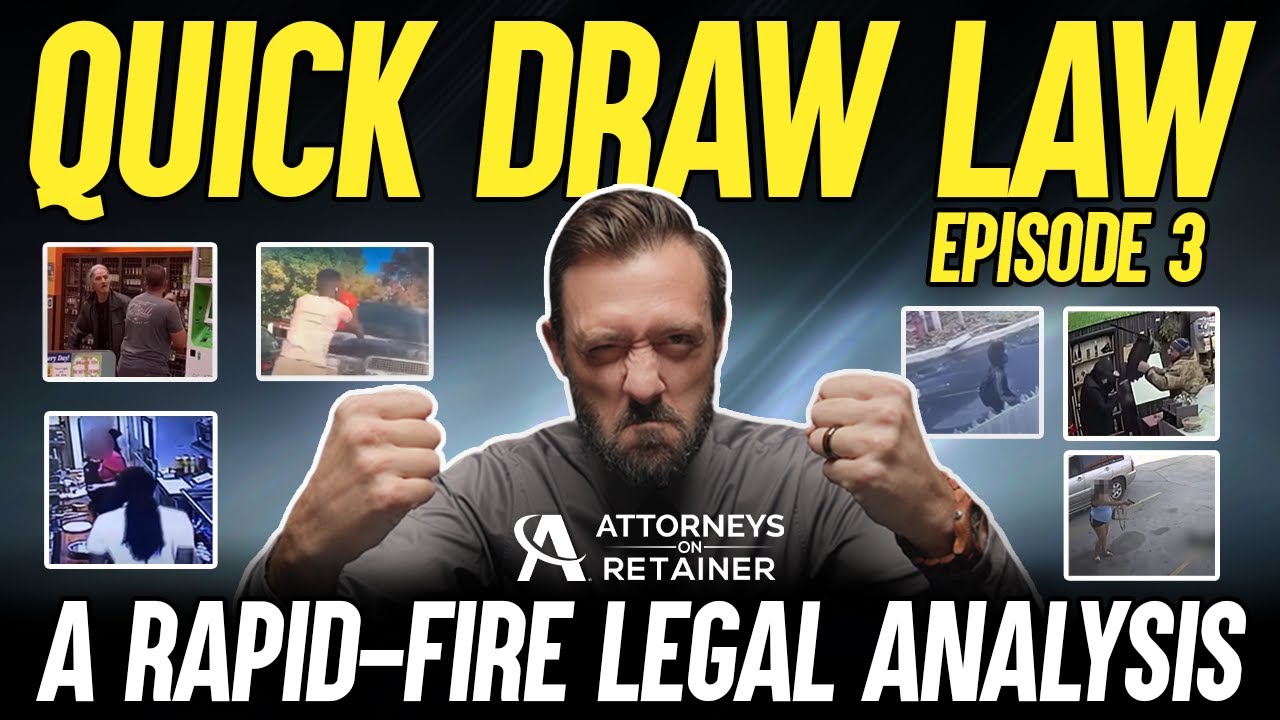
Quick Draw Law: A Rapid-Fire Legal Analysis by Criminal Defense Attorney Andrew Marcantel
October 18, 2024
Criminal defense attorney Andrew C. Marcantel analyzes six self-defense incidents, from gas station confrontations to poolside escalations. He examines legal principles, such as proportionality and stand your ground laws, to determine if these incidents were legally justified.
Case 1: The Pueblo County Parking Lot Shooting
In this incident, a physically imposing man confronts a much smaller man and forcefully shoves him into a car. The larger man then reaches into the smaller man’s vehicle, leading to a fatal shooting.
Attorney Marcantel emphasizes the legal principle of proportionality in self-defense incidents. This requires that any force used must reasonably match the level of threat faced. Though responding to a shove with a firearm may seem excessive, the aggressor escalated the threat by reaching into the defender’s occupied vehicle. Colorado’s Stand Your Ground law does not apply to vehicles. However, the prosecutor found the smaller man’s fear of being in imminent danger reasonable and filed no charges against him.
“Remember, there’s no law out there on the books that says you can’t bring a gun to a fist fight. It just says, you have to make sure that the force that you use in self-defense is proportional.”
– Attorney Marcantel
Case 2: North Carolina Property Defense Gone Wrong
This incident involved a bystander attempting to stop a carjacking by firing at the stolen vehicle. However, the bystander was fatally run over by the thief moments later.
Attorney Marcantel emphasized that you cannot use deadly physical force solely to protect property unless the threat escalates to endanger human life. Though the bystander had noble intentions, the law only permits firing a weapon when individuals are faced with an imminent threat of deadly force. Shooting at a stationary vehicle without an active threat is unlawful. If the bystander had survived, he could have faced charges. Attorney Marcantel also notes that the carjacker had no legal claim to self-defense since he was the initial aggressor.
“The baseline rule here is that, you may never use deadly physical force, only to protect mere property.”
– Attorney Marcantel
Case 3: Mississippi Gas Station Assault
This incident began with a man attacking a woman inside a gas station. He then assaulted another man who was sitting in a car outside. The car’s occupant responded by shooting the aggressor. As the aggressor retreated, the occupant chased after him, firing multiple shots. Another man (shooter number two) also fired at the fleeing aggressor. While the car’s occupant was likely justified in initially using deadly force under Mississippi’s stand your ground law, continuing to fire as the aggressor fled may have crossed the legal line. The second shooter had no legal justification to use his firearm.
Attorney Marcantel explains that the doctrine of reasonableness in self-defense allows for the use of deadly force only while the threat is ongoing or imminent. Once the aggressor was shot and began to retreat, the continued gunfire became highly questionable.
“Shooter number one appears initially to be a good shoot, but then shoots inappropriately after that, and shooter two looks like he’s just way off base.”
– Attorney Marcantel
Case 4: Texas Pool Confrontation
At a public pool, a verbal altercation escalated when a man displayed a firearm and placed it in his bag. The man in sunglasses then placed his bag within reach of the two men he had been arguing with. The two men grabbed the bag, attempting to disarm the man, which resulted in a struggle in the pool.
While the initial display of the gun could be argued as self-defense due to being outnumbered, the careless placement of the weapon made the situation dangerous. Legally, the two men were justified in attempting to disarm him once they were threatened. Had the gun discharged during the struggle, the man with the firearm could have faced charges.
“Once he has threatened those two guys with the firearm, they are absolutely allowed to disarm him at that point. If he’s coming at them with the gun, and he’s shown it, and he’s threatening to use it… they are 100% in their legal right to try to take that firearm.”
– Attorney Marcantel
Case 5: Sacramento Accidental Police Shooting
Police on patrol noticed a man abandon his vehicle and fled on foot. They discovered that the car’s registration had expired, providing them with probable cause to investigate further. After questioning uncooperative witnesses, they spotted the suspect hiding on top of an RV he did not own. When officers confronted him at gunpoint, he began rifling through his pockets and suddenly attempted to flee by leaping off the RV. In the process, an officer’s firearm discharged, grazing the suspect’s head. The suspect survived and was arrested for felony evasion.
The shooting was accidental, but the suspect’s actions activated legally justified use-of-force protocols. There was no legal requirement for the police to switch to non-lethal force. The prosecutors are unlikely to see the incident as misconduct. The suspect was later charged with offenses unrelated to the shooting. Narcotics were found in his vehicle.
Case 6: Gasoline Defense in Chile
In Chile, a man pumping gas was approached by three assailants who jumped out of a van. It is unclear if the three assailants carried a weapon. The man, unarmed, used the gasoline hose to repel them. While not subject to U.S. law, this would likely be considered a justified use of non-lethal force in the U.S. If the defendants had used deadly force, it could also have been justified. His quick thinking successfully prevented the attempted assault from escalating.
“There’s a really really good argument that this guy was actually facing imminent deadly physical force, and if he was armed with a firearm at that point, very arguably, he would have been able to discharge a round in self-defense.”
– Attorney Marcantel
Whether you’re protecting yourself or others, knowing the legal boundaries of legal self-defense is essential. That’s why having a knowledgeable legal team like The Attorneys On Retainer (AOR) can make a difference. If you would like to know more about our program and how AOR can help you, please call 866-404-5112 or email us.
About the Author
Criminal Defense Attorney Andrew C. Marcantel

Andrew C. Marcantel, a criminal defense attorney, serves as the managing partner of Attorneys For Freedom Law Firm. With a passion for freedom, individual rights, and government accountability, he avidly defends citizens’ rights and has aggressively represented clients in hundreds of major felony cases.
All Posts by Andrew C. Marcantel | Andrew C. Marcantel's Full BioHave a Question About AOR Membership?
Our team is ready to walk you through your options. Fill out the form and we’ll be in touch shortly.