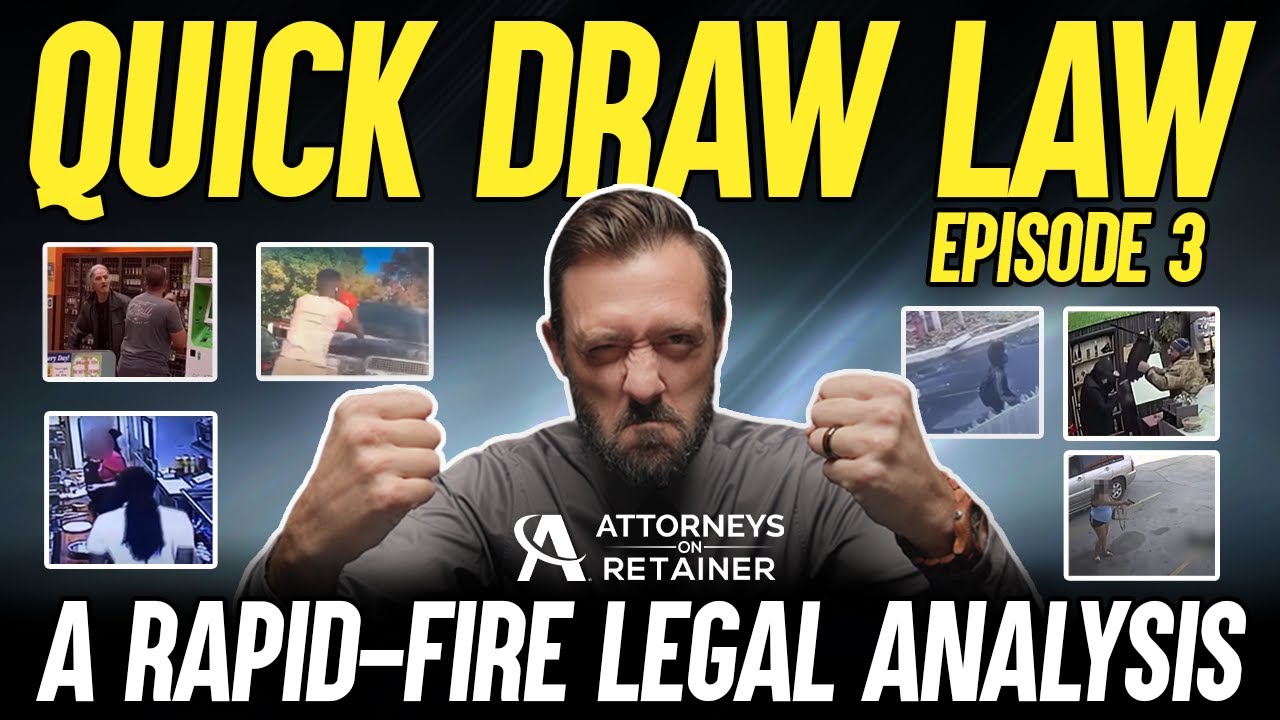
Quick Draw Law Ep. 2: A Rapid-Fire Legal Analysis by Criminal Defense Attorney Andrew Marcantel
Featuring Attorney Andrew Marcantel
January 10, 2025
In this episode of Quick Draw Law, criminal defense attorney Andrew C. Marcantel breaks down six real-life self-defense incidents. These incidents range from a 14-year-old hero in Philadelphia to a tragic shooting in Baltimore and a pit bull attack in Florida. Attorney Marcantel explores the concepts of prosecutorial discretion and reasonableness to determine whether these incidents were legally justifiable.
Case 1: The 14-Year-Old Hero in Philadelphia
In Philadelphia, a 14-year-old boy defended his family’s pizza shop from an attempted robbery. The suspect, who had recently robbed a nearby CVS, reached over the counter in a threatening manner before being shot by the teenager using a family-owned firearm.
“The general self-defense rules here are that you may never use deadly physical force to defend mere property.”
– Attorney Marcantel
Attorney Marcantel explains that deadly force is typically reserved for defense against an imminent threat of serious bodily harm or death, not theft. However, Pennsylvania, like many states, has a crime prevention statute that justifies the use of deadly force if it is to prevent the commission of a forcible felony, such as robbery. Ultimately, the prosecutors declined to file charges, acknowledging that the boy had acted reasonably under the circumstances.
Case 2: Mistaken Identity in Baltimore
In Baltimore, a heavily intoxicated man named Mr. Espinosa mistakenly attempted to enter the wrong home, believing it belonged to a friend. As his behavior escalated, banging on the door and yelling profanities, the homeowner, Mr. Dorsey, armed himself and called 911. When Mr. Espinosa pushed the door open, Mr. Dorsey fired a single shot.
“This was a 100% justified shooting. Mr. Espinosa was presenting a threat… any reasonable person inside of that home right there would have believed that this was an imminent break-in.”
– Attorney Marcantel
Attorney Marcantel discusses the castle doctrine, which allows a person to use deadly force to protect their home without a duty to retreat from the aggressor. The doctrine varies by state but generally permits homeowners to defend themselves against unlawful intrusions, especially when such behavior is accompanied by aggression.
Case 3: Brazilian Robbery
A couple wearing motorcycle helmets enters a Brazilian snack bar. The man immediately brandishes a firearm and begins robbing a customer while his female accomplice raids the cash register. However, the customer being robbed had a concealed firearm of his own. The customer fires two rounds, taking down both robbers. The woman, clearly injured, flees with the stolen goods, leaving her partner behind. Attorney Marcantel explains that if this incident had occurred in the United States, the shooter would likely be seen as a good Samaritan acting within his legal rights. The presence of a drawn weapon and the immediate threat to innocent lives make this a justified use of deadly force under U.S. law.
“As soon as the bad guy walked in, he immediately pointed the firearm, and threatened everybody… that is immediately posing a risk of deadly physical force.”
– Attorney Marcantel
Case 4: Virginia Doorstep Defense
In another incident, a man is seen unlocking his front door when someone suddenly approaches from around the corner, armed and masked. The homeowner quickly draws his weapon and shoots the intruder. In states like Virginia with strong self-defense statutes, this is justified force. Case law supports the right to use deadly force to prevent an imminent home invasion.
“Any reasonable person would think that they’re about to be either killed or have their home invaded.”
– Attorney Marcantel
Case 5: Defending a Pet
In Jacksonville, Florida, a woman shot a large dog that was mauling her small dog. This case highlights the legal gray area of defending property as it pertains to animals.
“The law basically treats them as if they are mere property… you can’t use deadly physical force against a person who is trying to kill your dog.”
– Attorney Marcantel
Despite this, the prosecutors exercised discretion and did not file charges. The woman had made multiple attempts to stop the attack using non-lethal means and only fired when all else failed. Her actions may have exceeded the legal limits, but they were seen as reasonable given the urgency.
Case 6: Kansas City Bar Attack
In Kansas City, a man previously kicked out of a bar for alleged sexual harassment returned, wielding a knife and threatening staff. In response, bar patrons defended themselves and others by pelting him with barstools until police arrived. Authorities confirmed the attacker was the only one arrested, and the use of force was ruled justified.
“I love it when I see a community come together like this in the Christmas season to throw some stools at a bad guy and get him the hell out of the bar.”
– Attorney Marcantel
Conclusion
These cases show that the law of self-defense is as much about judgment as it is about statutes. Clear-cut cases can be seen as unjustified by a single legal technicality, an aggressive prosecutor, or unclear video footage.
Whether you’re protecting your home, a loved one, or even your pet, knowing the boundaries of legal self-defense is essential. That’s why having a knowledgeable legal team like The Attorneys On Retainer (AOR) can make a difference. If you would like to know more about our law firm and how AOR can help you, please call 866-404-5112 or email us.
Have a Question About AOR Membership?
Our team is ready to walk you through your options. Fill out the form and we’ll be in touch shortly.