
Protecting Your Pet
By Rachel Moss, Esq.
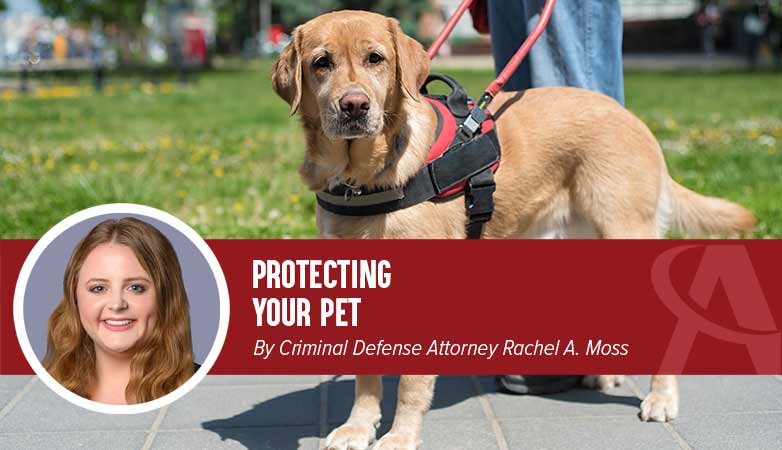
Your dog tugs on its leash as the two of you get closer to home. You can tell he is expecting a treat when you walk through the door, and you know you will probably give it to him. When you get to your house, you see a delivery driver dropping off a package. He yells, “Stop! I’m scared of dogs.” You say, “I live here – I’ll take him inside.” Your dog barks at the driver as he walks by; the next thing you know, the driver is attacking your pet. You are armed and trained, so you pull out your gun and point it at the attacker. The next thing you know, you are being arrested for Aggravated Assault.
You are shocked and confused, wondering why you are being arrested for protecting your pet. But did you know pets are considered property under the law? Generally, you cannot use deadly physical force to protect property. Because of this restriction, some people are arrested and charged for trying to protect their pets.
To understand the issue, we will look at:
- How the law classifies pets.
- When you can use deadly physical force; and
- When you can protect your pet.
The exact laws vary by state, but most jurisdictions follow similar general principles.
How the Law Classifies Pets

The law treats people and property differently. For example, a defendant charged with Aggravated Assault typically faces much higher penalties than someone charged with Criminal Damage.
In Arizona, a “person” is defined as a “human being” or “an entity capable of holding a legal or beneficial interest in property.”1 In contrast, “property” is defined as “anything of value, tangible or intangible.”2 A pet is something of value, so it is considered property under the law.
Some states are even more explicit in how pets constitute property. For example, California Penal Code Section 491 states, “companion animals are personal property, and their value is to be ascertained in the same manner as the value of other property.”
Understanding the difference between “person” and “property” is critical, as property is entitled to less protection under the law.
When You Can Use Deadly Physical Force

The law allows individuals to use deadly physical force to protect themselves and others under certain circumstances. Primarily, a person is justified in using deadly physical force against another when and to the extent a reasonable person would believe it is immediately necessary to protect himself from another’s unlawful deadly physical force. Depending on the state you are in, you may also be able to use deadly physical force to prevent certain serious crimes like murder or burglary.
While the law clearly allows individuals to protect themselves and others with deadly physical force, the law generally does not allow people to protect their property with deadly physical force. Because animals are considered property, a person cannot use deadly physical force to protect their pet from another person. However, this does not mean you are excluded from protecting your pet in every circumstance.
In most states, individuals can use ordinary physical force to protect their property. For example, Arizona law allows a person to use physical force to protect their property when necessary to prevent what they reasonably believe is another’s attempt at stealing or damaging their property. Therefore, an individual may use ordinary physical force to stop someone from stealing or hurting their pet.
When You Can Protect Your Pet

Although an individual may not use deadly physical force to protect property, and therefore cannot claim self-defense when protecting a pet from another person, most states allow individuals to protect their pets from other violent animals.
Many of these statutes specifically extend protection to livestock. For example, Arizona law states, “if any person discovers a dog killing, wounding or chasing livestock, …he may pursue and kill the dog.”3
Other states, like Florida, extend protection to all animals. Florida law provides a defense from liability for a person who kills a dog that is actively attacking any animal.4 Similarly, Pennsylvania law specifies a person may kill a dog it sees wounding or killing other pets or human beings.
These laws vary by state, so pet owners should research the circumstances under which they can protect their pets in their state.
Final Thoughts

Remember, while pets are valuable members of the family, you likely cannot assert self-defense or defense of others as a defense against a crime when protecting your pet. However, you may find yourself in a circumstance where you need to act in self-defense. If you do, you will want Attorneys On Retainer on your side.
Attorneys On Retainer is a self-defense protection program designed to support your legal needs after a self-defense incident. Learn about Attorneys On Retainer here. You can also learn about Attorneys For Freedom, the only law firm in the nation exclusively committed to self-defense cases, here.
All the best, Rachel Moss, Esq.
About the Author
Criminal Defense Attorney Rachel A. Moss

Rachel Moss is a criminal defense attorney and author of The Attorneys On Retainer blogs. With a dedication to defending her clients and supporting the liberty movement, Rachel believes in giving people second chances to their freedom and fights for justice.
All Posts by Rachel A. Moss | Rachel A. Moss's Full BioHave a Question About AOR Membership?
Our team is ready to walk you through your options. Fill out the form and we’ll be in touch shortly.