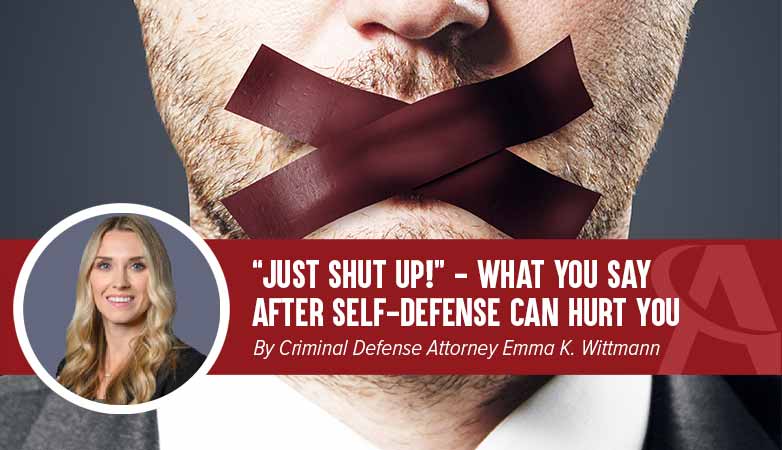
“Just Shut Up!”
What You Say After Self-Defense Can Hurt You
By Emma K. Wittmann, Esq.
After a self-defense incident, many people believe the best thing they can do is immediately tell law enforcement, “I was defending myself.” While that may seem logical, making any statement—no matter how short—can create significant legal problems down the road.
As criminal defense attorneys, one piece of advice we frequently give is simple: do not make a statement to police until you have spoken with an attorney, or put another way, “Just shut up!”
Your Statement May End up Being the Worst Piece of Evidence in Your Case
No two cases are the same. Every self-defense claim involves unique facts, evidence, witnesses, and legal issues. Because of that, there is no one-size-fits-all statement that works in every situation.
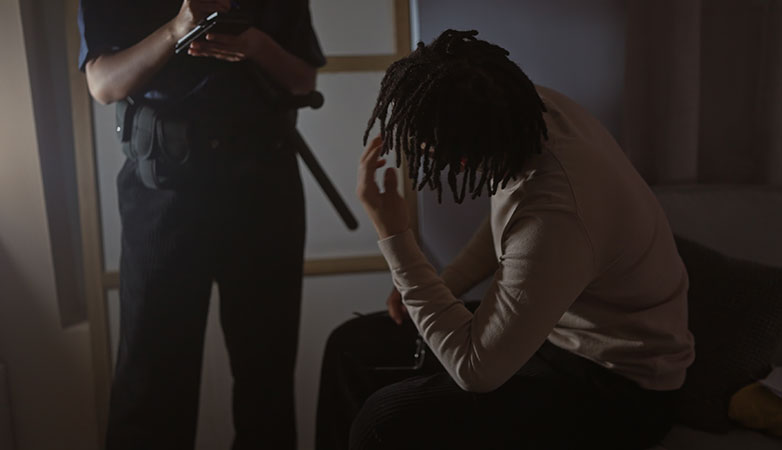
What we can say generally is that speaking to police immediately after a shooting, stabbing, or other use of force is often far riskier than people realize.
Law enforcement is not only evaluating what you say—they are also evaluating what you leave out. Following a traumatic event, your body is flooded with stress and adrenaline. Even if you are completely innocent, you may struggle to recall details accurately or tell the story in a clear, chronological way.
A statement made during those moments can become powerful evidence against you later. Remember, “Just shut up!”
A Self-Defense Statement May Limit Other Defenses
Many people assume that saying “I acted in self-defense” can only help them. In reality, that statement may unintentionally lock you into a specific legal theory before all the facts are known.
Keep in mind that self-defense can be used as a legal justification for actions that might otherwise be considered criminal. By immediately claiming self-defense, you may be foreclosing other defenses that your attorney could potentially raise after reviewing the evidence.
For example, there may be identification issues, witness credibility concerns, questions about who initiated the confrontation, or evidence showing you were defending a third party rather than yourself. An attorney needs time to investigate those possibilities before deciding on the best legal strategy.
Simply put, do not make your attorney’s job harder by committing to a narrative before the investigation has even begun.
Statements Can Be Misunderstood and Mischaracterized
At the scene, law enforcement officers are conducting an investigation and determining whether probable cause exists to believe a crime occurred. Probable cause is a relatively low legal standard that allows officers to make an arrest when they have sufficient facts to believe a crime may have been committed.
You do not get to choose which officer responds to your case. Your words may be interpreted differently than you intended. A statement that sounds rehearsed may appear suspicious. A statement that lacks emotion may be viewed negatively. It’s also not just what you say, but what you leave out. An officer may misunderstand your explanation or later summarize it inaccurately when drafting their report and presenting the case to prosecutors.
Even truthful statements can create problems when taken out of context. Remember the rule, “Just shut up!”
Think About Long-Term Freedom, Not Immediate Arrest

Many people make statements because they believe they can talk their way out of being arrested. That is often a mistake.
Your primary concern should not be avoiding a temporary arrest. It should be protecting your long-term freedom.
Anything you say can be scrutinized by investigators, prosecutors, and jurors months or even years later. Assume every word will be analyzed, challenged, and potentially misconstrued at trial.
Together, with your attorney, a strategy can be developed to determine when the best time is to present your side of the story. Most important is your long-term freedom, not just avoiding momentary arrest.
Call an Attorney First
After a self-defense incident, contact an attorney as soon as possible and invoke your right to counsel. An experienced attorney can evaluate the facts, review the evidence, communicate with law enforcement, and determine whether making a statement is in your best interest.
Most importantly, you are not required to make a rushed decision in the immediate aftermath of a traumatic event. You have the entire course of the investigation and criminal case to develop a strategy with counsel regarding if, when, and how a statement should be made.
Do not leave your future to a scripted response or a split-second decision. Following a self-defense incident, your first call should be to an attorney—not an explanation to the police.
At the end of the day, the goal is not simply to avoid arrest in the immediate aftermath of a self-defense incident—it is to protect your long-term freedom. The statements you make in the first few minutes after a traumatic event can have lasting consequences and may ultimately become some of the most important evidence in your case. While every situation is different and requires individualized legal advice, one principle remains constant: before making any statement to law enforcement, speak with an attorney. A carefully considered legal strategy developed with counsel is far more valuable than a rushed explanation given under stress. When your future is on the line, silence is often your strongest protection. Remember, after a self-defense incident, “just shut up” and call Attorneys On Retainer.
About the Author
Criminal Defense Attorney Emma K. Wittmann

Emma K. Wittmann, a dedicated criminal defense attorney and author on The Attorneys On Retainer blogs, tirelessly defends clients in felony cases with aggression and expertise, ready to advocate for you.
All Posts by Emma K. Wittmann | Emma K. Wittmann's Full BioHave a Question About AOR Membership?
Our team is ready to walk you through your options. Fill out the form and we’ll be in touch shortly.