Imperfect Self-Defense: When a Genuine, but Unreasonable Belief Comes at a Cost
By Emma K. Wittmann, Esq.
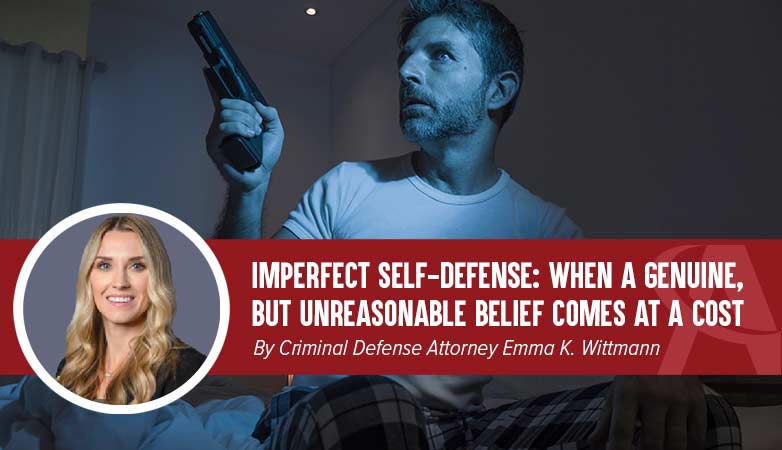
Self-defense is often viewed as an all-or-nothing defense. Either the defendant was legally justified in using force, or they were not. However, some jurisdictions recognize an intermediate doctrine known as imperfect self-defense, which acknowledges that a defendant may have honestly believed force was necessary even though that belief was legally unreasonable. While this doctrine does not provide a complete justification, it can significantly reduce criminal liability.
Comparing Perfect vs. Imperfect Self-Defense
Under the traditional doctrine of self-defense, a defendant is justified in using force only when they reasonably believe such force is immediately necessary to protect themselves against another’s unlawful use of force. The reasonableness requirement contains both subjective and objective components. The defendant must actually believe force is necessary, and that belief must be one a reasonable person in the same circumstances would have held.
Imperfect self-defense applies when the first requirement is met but the second is not. In other words, the defendant genuinely believed they were facing an imminent threat requiring defensive force, but that belief was objectively unreasonable. Rather than treating the defendant as fully justified, jurisdictions recognizing the doctrine treat the defendant’s mistaken perception as mitigating.
Imperfect Self-Defense Is NOT a Complete Defense

The doctrine most commonly arises in homicide cases. A defendant who intentionally kills another under an honest but unreasonable belief that deadly force was necessary may seek an imperfect self-defense jury instruction. If the jury finds imperfect self-defense, the defendant avoids a murder conviction and instead will be convicted of a lesser included offense, such as voluntary manslaughter. The sentence the defendant will receive under a voluntary manslaughter conviction, compared to murder, could make all the difference in the person facing a life sentence, or a shorter sentence that allows them to rejoin society.
The rationale is that although society cannot excuse the unreasonable use of deadly force, the defendant’s genuine fear makes them less morally blameworthy than someone who intentionally kills without any perceived need for self-protection.
State Recognition, Rejection, and the In-Between
States differ dramatically in their treatment of imperfect self-defense. California is perhaps the best-known example of a jurisdiction recognizing the doctrine, where it operates to negate the malice required for murder. Other states have adopted similar approaches through statute or case law, while many jurisdictions reject the doctrine altogether and require a defendant to satisfy every element of lawful self-defense before receiving any justification.
Arizona falls into the latter category. Arizona’s justification statutes require that a defendant’s belief in the necessity of force be reasonable. If the defendant’s belief is found to be objectively unreasonable, the justification defense fails. Arizona has not adopted imperfect self-defense as a partial defense that reduces murder to manslaughter simply because the defendant acted under an honest but mistaken belief regarding the need for force.
There are also states, such as Texas, that recognize imperfect self-defense, but only during the sentencing phase. At trial, imperfect self-defense cannot be raised; a defendant would be found guilty of murder. However, at sentencing, defense counsel can argue imperfect self-defense, and the jury can mitigate the recommended sentencing range from that of a murder conviction to a lesser sentence equivalent to that of a manslaughter conviction.
That does not mean evidence of a defendant’s subjective belief is irrelevant in Arizona. A defendant’s perception of danger may still be highly relevant to issues such as intent, premeditation, recklessness, or the credibility of witnesses. The defense of Mistake of Fact may also be considered. In appropriate cases, evidence explaining why a defendant believed they were in danger may persuade a jury that the State has failed to prove the required mental state beyond a reasonable doubt, even though the justification defense itself ultimately fails.
Although imperfect self-defense is not recognized in every state, it remains an important concept to understand. It reflects the legal system’s attempt to account for human error under extreme stress while maintaining objective limits on the lawful use of force.
A Limited Doctrine with Limited Protection

The fact that many jurisdictions do not recognize imperfect self-defense serves as a stark reminder that the law expects individuals to act reasonably, even in high-stress situations where fear and emotion can cloud judgment. In the limited states recognizing the doctrine, imperfect self-defense only reduces the time one serves in prison. The difference from perfect self-defense is profound. A successful claim of perfect self-defense restores a person’s freedom by resulting in an acquittal, while imperfect self-defense merely reduces the degree of criminal culpability.
The central question is whether an honest but unreasonable mistake should merely mitigate criminal responsibility or provide no legal benefit at all. A majority of states have chosen the latter approach, preserving a bright line that requires both an actual and objectively reasonable belief before conduct is legally justified.
Understanding where lawful self-defense ends—and where mistaken but genuine perceptions of danger begin—is essential for anyone who carries a firearm or may one day be forced to defend themselves. Reasonableness is not just a legal term; it is the foundation of a complete self-defense claim and can mean the difference between walking away without a conviction and facing serious criminal consequences.
About the Author
Criminal Defense Attorney Emma K. Wittmann

Emma K. Wittmann, a dedicated criminal defense attorney and author on The Attorneys On Retainer blogs, tirelessly defends clients in felony cases with aggression and expertise, ready to advocate for you.
All Posts by Emma K. Wittmann | Emma K. Wittmann's Full BioHave a Question About AOR Membership?
Our team is ready to walk you through your options. Fill out the form and we’ll be in touch shortly.