How the Supreme Court Kept Hawaii’s “Vampire Law” From Sucking the Life Out of Bruen
By Howard A. Snader, Senior Criminal Defense Attorney, Attorneys For Freedom Law Firm
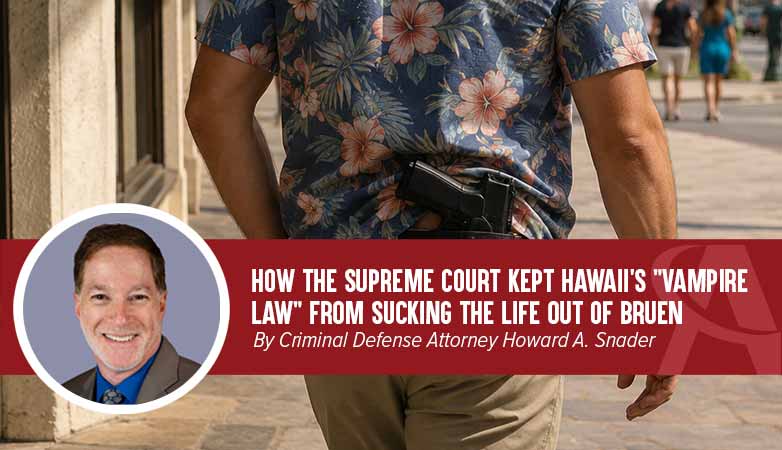
The United States Supreme Court recently handed Second Amendment supporters another significant victory in Wolford v. Lopez. At issue was a Hawaii law that attempted to accomplish indirectly what New York State Rifle & Pistol Association v. Bruen had already forbidden directly.
Rather than banning licensed concealed carry altogether, Hawaii changed the default rule. Instead of allowing licensed citizens to carry into businesses open to the public unless the owner chose to prohibit firearms, Hawaii presumed firearms were prohibited unless the owner expressly invited them inside.
The Supreme Court recognized Hawaii’s attempt to drain the practical effect out of Bruen one invitation at a time. In declaring the law unconstitutional, it drove a constitutional stake through the heart of the state’s “Vampire Law.”
Why the Nickname?

Hawaii had effectively adopted one of the oldest rules in vampire folklore: before crossing the threshold of private property, a vampire must first receive an invitation. Hawaii imposed much of the same rule on licensed concealed carriers. Unless the property owner affirmatively welcomed them, Hawaii made it illegal to cross the threshold with a firearm. This was the case even if the owner had never objected to firearms in the first place.
The Hawaii law was simple: No invitation. No entry.
It’s a great plot device for horror movies.
It’s a terrible foundation for constitutional law.
After Bruen, Hawaii understood it could no longer broadly deny law-abiding citizens the right to carry firearms in public for self-defense. So rather than confronting Bruen head-on, Hawaii rewrote the rules of entry.
For centuries, the common-law rule has been straightforward. When a business opens its doors to the public, customers are generally free to enter unless the owner decides otherwise. If the owner wishes to prohibit firearms, the owner would post a sign or otherwise give notice. The final decision belongs to the property owner, and the default presumption favors lawful entry.
Hawaii reversed that presumption.
Overnight, every grocery store, gas station, restaurant, pharmacy, hardware store, sporting goods store, coffee shop, and retail business became a presumptive gun-free zone—not because their owners wanted it that way, but because the government declared it so.
Unless a business owner affirmatively invited licensed concealed carriers inside, simply walking through the front door while lawfully armed could expose an otherwise law-abiding citizen to criminal liability.
No invitation. No entry.
The “Vampire Law” may be a funny nickname, but the constitutional issue was not.
At its core, Wolford asked one deceptively simple question:
Can a state accomplish indirectly what the Supreme Court has already said it cannot do directly?

That question reaches well beyond the Second Amendment. Legislatures frequently respond to adverse court decisions by changing tactics instead of changing objectives. If one restriction is declared unconstitutional, another appears wearing different clothes. Labels change. Procedures change. Default rules change. Yet the constitutional burden often remains exactly the same.
Justice Samuel Alito’s majority opinion looked past Hawaii’s label and focused on the law’s practical effect.
The Court recognized that Hawaii wasn’t merely adjusting an obscure rule of property law. It was fundamentally changing the way ordinary citizens exercise a constitutional right. A licensed concealed carrier could no longer stop for gas, pick up groceries, grab lunch, visit the pharmacy, or run everyday errands without first determining whether each business owner had granted affirmative permission to carry a firearm. In the Court’s own hypothetical, an otherwise law-abiding woman simply trying to go about her day could unknowingly commit multiple criminal offenses before dinner.
That’s what makes Wolford so important. Constitutional rights are exercised in grocery stores, parking lots, pharmacies, and restaurants: not just in courtrooms or law school classrooms.
A constitutional right that cannot be exercised during ordinary life is little comfort to the ordinary citizen.
Hawaii defended its law by pointing to historical statutes governing hunting and trespassing, even citing an 1865 Louisiana law requiring permission to carry firearms onto another’s property. The Court rejected those comparisons, explaining that colonial anti-poaching laws regulated unauthorized hunting: not peaceful concealed carry for self-defense. The Court gave no meaningful weight to a Reconstruction-era Black Code enacted to disarm newly freed African Americans. Under Bruen, history matters, but the Court noted the importance of understanding the history being relied upon.
Equally important is what Wolford did not decide.
Businesses remain free to prohibit firearms on their property. Property rights remain property rights. Trespass laws remain enforceable. Litigation over “sensitive places” will continue. Wolford does not create a constitutional right to ignore a business owner’s wishes.
The Court rejected the government’s ability to make prohibition the default when the Constitution protects the underlying conduct.
That distinction matters.
Defense attorneys learn early in their careers that constitutional rights are seldom attacked head-on. More often, they are narrowed incrementally through additional paperwork, procedural hurdles, licensing requirements, administrative burdens, or carefully crafted exceptions. Viewed individually, each restriction may seem modest. Taken together, they can leave citizens wondering whether exercising a constitutional right is worth the legal risk.
Rights protected by the Constitution can be weakened just as effectively by a thousand small obstacles as by one sweeping prohibition. The Supreme Court recognized that danger in Wolford and refused to allow a procedural workaround to accomplish what the Constitution forbids.
Hawaii attempted to drive a stake through the heart of the Second Amendment by draining Bruen of its practical effect. The Supreme Court recognized the vampiric overreach before Hawaii, or any other State, could finish the job.
We fended off the vampires.
This time.
What This Means for Gun Owners
- Businesses may still prohibit firearms.
- Wolford does not invalidate trespass laws.
- The decision affects the default rule, not private property rights.
- Other states with similar laws should expect renewed constitutional challenges.
About the Author
Senior Criminal Defense Attorney

Howard joined Attorneys For Freedom to continue his focus on providing vigorous defense, with special emphasis on self-defense cases and protecting constitutional rights. His practice blends relentless courtroom advocacy, creative problem-solving, and disciplined case management.
All Posts by Howard A. Snader | Howard A. Snader's Full BioHave a Question About AOR Membership?
Our team is ready to walk you through your options. Fill out the form and we’ll be in touch shortly.