Attorneys On Retainer Analyzes Tyreek Hill’s Arrest: Where Did He Go Wrong?
September 20, 2024
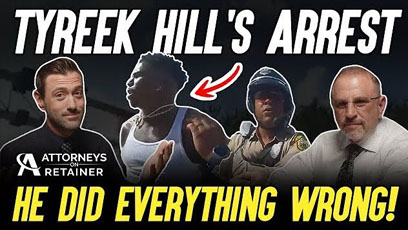
The roadside arrest of NFL wide receiver Tyreek Hill has sparked public debate about law enforcement practices, individual rights, and the balance of power during traffic stops. Criminal defense attorneys Marc J. Victor and Andrew C. Marcantel discuss the incident and examine how the Fourth Amendment applies to everyday life.
The Fourth Amendment and Traffic Stops
The foundation of this case is the Fourth Amendment, which guards against unreasonable searches and seizures. The attorneys emphasize that the moment a police officer activates their lights and initiates a stop, that act constitutes a seizure. For such a seizure to be lawful, the officer must have reasonable suspicion that a traffic violation or criminal offense has occurred. In Mr. Hill’s case, available evidence suggests he was speeding through a construction zone. That was enough to validate the stop under both Florida law and U.S. Supreme Court precedent.
“First question that always enters your mind when you’re a criminal defense lawyer is you’ve got an interaction, right, what we call a seizure… [police] don’t get to just do that. They have to have what we call reasonable suspicion that a crime has been committed or they witnessed a traffic violation.”
– Attorney Victor
Reasonable Suspicion
The standard for reasonable suspicion is quite low. If an officer believes, in good faith, that a violation happened, even if mistaken about the law, a stop can still be justified. Therefore, whether you violated the law may not be relevant. If the officer reasonably believes you did, the stop is likely constitutional.
“There are multiple jurisdictions that… have said even if the officer is mistaken about the traffic violation… as long as they in good faith believed it, that’s going to satisfy Fourth Amendment muster.”
– Attorney Marcantel
An Order To Get Out of Your Vehicle
A major point of confusion during traffic stops is whether drivers are required to exit their vehicles when instructed to do so. The attorneys agree that the legal answer is “yes.” In Pennsylvania v. Mimms (1977), the U.S. Supreme Court ruled that officers may order a driver out of a vehicle during a lawful stop for any reason, or even no reason. This was extended to passengers in Maryland v. Wilson (1997). Failure to comply with such an order can result in the use of reasonable force. The police were well within their authority to escalate when Mr. Hill refused multiple commands to exit the car.
“If that officer says ‘get out of the car,’ this is not a time to play games. You are getting out of that car.”
– Attorney Victor
Professionalism and Legality
Much of the public backlash has focused on the demeanor of the officers involved. The shouting, use of aggressive language, and perceived lack of courtesy raised concerns. However, the attorneys stress that unprofessional conduct does not mean illegality. The officer’s behavior may warrant internal review or disciplinary action, but it does not constitute a Fourth Amendment violation.
“You don’t have a constitutional right to a courteous police officer.”
– Attorney Victor
Credibility and Legal Strategy
The attorneys emphasized the risks associated with speaking too openly during interactions with law enforcement. Spontaneous, false, or exaggerated statements can be used against you in court. Mr. Hill’s teammate repeatedly shouted that the officers were “beating” Mr. Hill while Mr. Hill made claims about a recent surgery. If these assertions prove false, they could hurt credibility and may be used to impeach during cross-examination.
“Tyreek didn’t follow rule number one, which is just shut up, when you’re interacting with the cops… even spontaneous statements like this can end up hurting you in your case.”
– Attorney Marcantel
False Narratives and Racial Injustice
After the incident, Mr. Hill stated, “I was just being a Black man in America.” The attorneys warn against using isolated incidents to stir public outrage based on a misleading version of events. This type of statement, especially when contradicted by body camera footage, undermines the credibility of genuine victims of systemic abuse and racial bias.
Attorneys For Freedom Law Firm is solely dedicated to representing individuals involved in self-defense incidents through our Attorneys On Retainer Program (AOR). To learn how the AOR Program can protect you, please call 866-404-5112 or email us.
Have a Question About AOR Membership?
Our team is ready to walk you through your options. Fill out the form and we’ll be in touch shortly.