Are You Ready to Testify?
By Criminal Defense Attorney Joey Hamby

Few questions create more fear or anxiety than asking, “Are you ready to testify?”
I have represented thousands of defendants, and that question strikes fear into the hearts of every defendant in a criminal case. This is particularly true in self-defense cases where a defendant is much more likely to have to testify. In many self-defense cases, there are only two witnesses, and one of them is dead.
In most jurisdictions, self-defense is an affirmative, justification defense. That means you can be charged with murder or some other crime, and it is your job to put forward the legal claim that your actions were fully justified because you were in reasonable fear of imminent death or serious bodily injury. I have represented many defendants who were asserting self-defense, and I prepared every one of them to testify. No one is going to tell your story the way that you can. In many cases, there is no one else to tell the story at all.
If you are involved in a self-defense event, you generally begin testifying before you even meet your defense attorney. Remember those Miranda warnings you see in the movies? Remember that phrase, “anything you say can and will be held against you?” By the time you hear that warning in most cases, you have already been testifying for quite some time.
The statements you made on the 911 call, to the paramedics, to the first responding officers, along with your physical actions, your facial expressions, your body language, your emotional composure, and the tone of your communications, all will be measured by officers, prosecutors, judges, and jurors. The things that you don’t say, or do, will also be held against you. I don’t know how many times I have heard a detective or a prosecutor comment that a defendant seemed “emotionless” or “didn’t cry” or “wasn’t shaken up” in the way that they thought the person should be. As if there is some uniform script that we all follow when we experience a horrific and traumatic event.
As a defendant, you are always testifying, during pretrial hearings, during jury selection, during the trial as others are testifying, during your own testimony, during opening and closing arguments. Jurors watch defendants constantly, looking for reactions, body language, facial expressions, and any number of clues to give them a window into what the defendant is thinking.
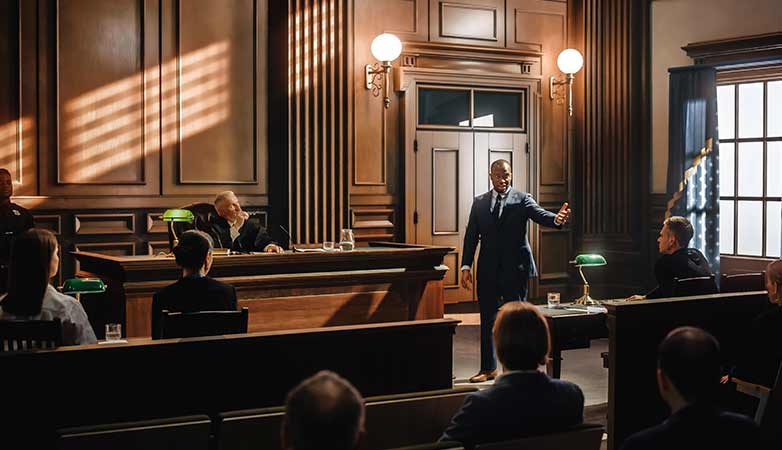
The courtroom is rarely like what we see on TV. There is no dramatic background music, and “surprise” evidence rarely appears at the last second. In reality, testifying—whether as a witness or a defendant—is a high-pressure environment where your words carry permanent legal weight. And failure to prepare for that pressure is often fatal to the case.
If you’re feeling anxious about taking the stand, you aren’t alone. Here is a breakdown of common concerns and how to navigate the process.
The Core Concerns
Most people fear the unknown. In a criminal case, those fears usually fall into a few categories:
- Cross-Examination: The fear of being “tricked” or made to look like a liar by the opposing attorney.
- Safety and Retaliation: Concerns about the repercussions of speaking out against another person.
- The “Blank Out”: The worry that nerves will cause you to forget critical details under pressure.
How to Prepare

Preparation isn’t about memorizing a script; it’s about understanding the mechanics of the truth. Here are a few important things to understand.
Your memory is fallible - review your statements
If you gave a police report or a deposition months ago, read it again. Consistency is the hallmark of a credible witness. If your memory has faded or changed, discuss this with your attorney before you get to court.
Understand the “Yes or No” trap
Attorneys often use “leading questions” to box you into a specific narrative. Remember: if a question cannot be answered with a simple “yes” or “no” without being misleading, you have the right to say, “I can’t answer that with a yes or no,” or to ask for clarification.
Master your composure
The jury isn’t just listening to your words; they are watching your body language.
Wait for the full question: Don’t interrupt, even if you know where the lawyer is going.
Speak to the jury: When answering, look at the jurors. They are the ones who need to hear you.
Stay calm: If an attorney becomes aggressive, stay polite. If you lose your temper, you lose your credibility.
It is okay, and even good to show genuine emotion. But don’t let the opposing attorney goad you into an angry or thoughtless reaction.
It’s okay to not know the answer
“I don’t know” and “I don’t recall” are perfectly valid, truthful answers. Never guess. If you estimate a distance or a time, make sure you label it as an estimate.
Practice, Practice, Practice
I cannot recall ever putting a client on the stand to testify in a case without preparing them. Usually, it takes a lot of preparation. Very few clients have ever testified. The rules of evidence are often complicated and confusing. There are often previous court rulings that limit what can be said. And the stress is enormous. Cross-examination is not a conversation – it is a deadly serious attack by a skilled litigator.
I have taken clients into an empty courtroom and put them in the stand. I have spent hours working with a client to make sure that the presentation is clear and crisp. I have helped other attorneys and had them help me, by acting as the prosecutor to cross-examine clients as brutally as possible. We work to think of every possible attack and how to respond to each one. Several clients have gone through our practice sessions and then testified at trial. They often get done testifying and tell us how much easier testifying was than our practice sessions. I take that as the greatest compliment, because I have seen witnesses testify without preparation, and it isn’t pretty.
Testify or Not?

As a defendant, the decision to testify is yours alone, though you should lean heavily on your lawyer’s advice. You have a Fifth Amendment right to remain silent, and the jury is instructed that they can’t hold that silence against you.
If you do choose to testify, you waive that right and must answer every question the prosecution throws at you. This is a strategic “all-in” move that requires intense preparation and a very thick skin.
The Bottom Line
Courts run on testimony. While the process is intimidating, the goal is to provide the facts in a clear, understandable, and believable narrative. By preparing with your trial lawyer, reviewing your prior statements, staying calm, and being honest about what you don’t remember, you can navigate the witness stand with confidence.
About the Author
Criminal Defense Attorney Joey N. Hamby

Joey Hamby is a senior criminal defense attorney, a certified specialist in criminal law, and an author on The Attorneys On Retainer blogs. With decades of experience in self-defense cases, he is dedicated to protecting the rights and freedoms of responsible gun owners.
All Posts by Joey N. Hamby | Joey N. Hamby's Full BioHave a Question About AOR Membership?
Our team is ready to walk you through your options. Fill out the form and we’ll be in touch shortly.