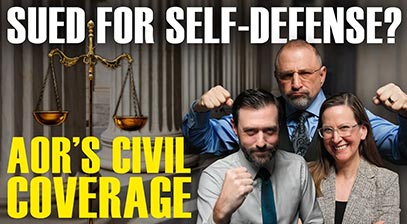
AOR Will Cover You Even When You Have a CCW Permit That Is Invalid, Expired, or Nonexistent
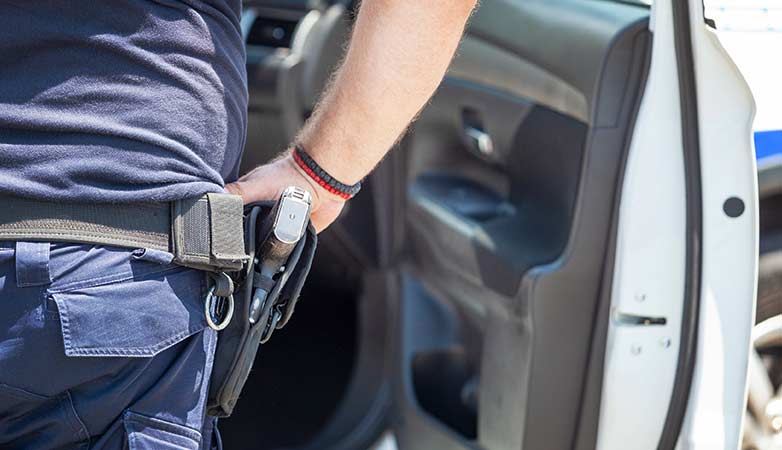
If you carry a firearm for self-defense, you may have a valid concealed carry weapons (CCW) permit, or you might live in a state where no permit is required. In either case, you have taken this responsibility seriously by following the law and meeting your jurisdiction’s requirements in good faith. However, circumstances can change. Permits can expire, regulations may change, and crossing state lines could render a previously valid permit invalid or unrecognized.
Regardless of whether your permit has expired, is no longer recognized due to a location change, or was never issued at all, administrative technicalities should not undermine the right to defend your life. Unfortunately, most traditional self-defense insurance programs treat these scenarios differently. If your CCW permit is expired, invalid under local laws, or nonexistent, traditional self-defense insurance programs may use this as a reason to deny coverage, even if your use of force was lawful and justified.
For most people, such circumstances seem like a minor oversight. However, if you ever find yourself needing to defend your life or someone else’s, such a technicality could mean the difference between receiving full legal representation and being left to navigate the situation alone.
With The Attorneys On Retainer Program (AOR), we impose no such restrictions. We provide complete legal representation to our members, regardless of the status of their CCW permit. At AOR, we believe that a technicality in a permit should not prevent you from accessing legal protection. Your right to self-defense does not disappear due to paperwork, and neither should your access to an attorney.
What is a Concealed Carry Permit
A CCW permit is a government-issued license that allows a person to carry a concealed firearm in public. While laws differ by state, many areas require a CCW permit as proof that the individual has met specific legal standards, such as background checks, firearms training, and residency requirements. It is important to note that the legal framework surrounding CCW permits can be complex and inconsistent across different states.
A permit is deemed expired when it is no longer valid due to the passage of time or failure to renew it. It can also become invalid if the permit holder moves to a state that does not recognize the original permit, or if the permit no longer complies with updated legal standards.
In jurisdictions that allow constitutional carry, no permit is required, enabling individuals to lawfully carry a firearm without obtaining one. However, if that individual travels to a state that necessitates a CCW permit and needs to defend themselves, lacking a permit could result in legal issues. While these differences may seem minor, they can significantly impact coverage under many traditional self-defense insurance programs.
Self-defense programs backed by traditional insurance providers often contain fine-print exclusions that deny coverage if your CCW permit is not valid at the time of the incident. Common technical violations that can render a permit invalid include:
- Lack of Reciprocity: A permit issued by one state may not be recognized by another. For instance, if someone has a valid CCW permit from Arizona and travels to a state that does not recognize Arizona permits, that permit is invalid there, even if it is still “active.”
- Change in Residency: Some states require that a CCW permit holder be a resident of the issuing state. If you move out of that state, your permit may automatically become invalid even if the expiration date has not passed.
- Non-Compliance With State-Specific Laws: If the permit was obtained without meeting updated legal requirements (e.g., new training mandates or eligibility changes), it may no longer be valid.
- Suspension or Revocation: A permit can be administratively suspended or revoked for various reasons, such as a criminal charge, a restraining order, or failure to meet renewal criteria, even if the physical permit was not reclaimed or destroyed.
- Fraud or Misrepresentation: If the permit was obtained through false information or is found to be forged or altered, it is legally invalid.
Under these policies, even a minor paperwork error can result in the cancellation of your coverage the moment you need it the most. This is not a coincidence; it is a deliberate risk-management strategy designed to reduce the insurer’s liability rather than to protect your liberty.
Why This Matters
The number of Americans holding CCW permits is substantial, with over 21 million nationwide as of 2024 (Lott Jr. et al., 2024). However, many of these permits either lapse, become invalid, or are never obtained in states where constitutional carry laws are in effect. This situation leaves a significant portion of law-abiding citizens at risk if they rely solely on traditional self-defense insurance programs, which often deny claims due to technical or administrative issues.
For instance, while approximately 8.2% of U.S. adults hold CCW permits (Lott Jr. et al., 2024), even a small fraction losing coverage due to expiration or invalidity would represent hundreds of thousands of individuals. When people believe they are covered but discover too late that their permit was invalid or nonexistent at the time of an incident, the consequences can be severe, resulting in criminal penalties, legal fees, and even loss of freedom.
This is why a self-defense program like AOR, which supports members regardless of their permit status, is essential.
The Attorneys On Retainer Advantage
AOR was founded on the principle of defending individuals who act in self-defense. Our members will not be denied legal representation simply because their CCW permit has expired, is invalid, or does not exist. Whether you forgot to renew your permit last month or you crossed into a state with different reciprocity laws, if you used lawful force to protect yourself or someone else, we will represent you.
In stark contrast to AOR, many self-defense programs supported by traditional insurance providers are overseen by strict regulatory frameworks and risk-management protocols. As a result, these programs often deny coverage if a self-defense act involves a firearm carried on an expired, invalid, or otherwise noncompliant permit.
AOR is backed by The Attorneys For Freedom Law Firm (AFF), not an insurance company. We created our own Risk Retention Group (RRG) to operate independently of traditional insurance practices and regulations, allowing us to set our own standards for legal representation.
Our team of experienced criminal defense attorneys is dedicated to defending your freedom, not second-guessing whether your permit is current, recognized, or required. That is why we do not deny coverage solely on the basis of your permit’s validity. If your case meets our three established criteria, we will represent you.
- You are charged (or are reasonably concerned about being charged) with a crime (felony or misdemeanor).
- You can reasonably and in good faith assert that you acted in self-defense or defense of others.
- The charges arise out of conduct that occurred entirely after you became a member of Attorneys On Retainer.
Real-Life Scenarios Where We Will Not Disqualify You
Here are some examples where traditional self-defense insurance programs might deny coverage, but we will not:
- You recently moved to another state, and your previous state’s CCW permit is no longer recognized under local reciprocity laws.
- You forgot to renew your permit, and it expired a few weeks before the incident occurred.
- You live in a constitutional carry state and have never needed a permit, but you used force while traveling in a state that requires one.
- You applied for a permit but were still waiting for approval at the time of the incident.
- Your permit was administratively suspended due to an unresolved legal or clerical issue of which you were unaware.
- You hold a non-resident permit from another state, but local law enforcement disputes its validity in your current jurisdiction.
Under traditional self-defense insurance programs, any of these situations would likely result in a denial of coverage. With AOR, however, none of these circumstances disqualify you from receiving legal assistance for your self-defense case. While carrying an expired or invalid permit may violate a statute; it does not eliminate your right to defend your life.
Conclusion
When your life is at stake, a clerical error or a missed renewal date should not hinder your access to qualified legal representation. At AOR, we focus on whether you reasonably acted in self-defense, rather than getting lost in the fine print. Our attorneys are dedicated to defending our members in court when it matters most. If you acted in self-defense and your case meets our three criteria, we will represent you.
Read our full “We Cover You Even If…” series to see how far that commitment goes.
AFF is solely dedicated to representing individuals involved in self-defense incidents through our AOR Program. To learn more about how The AOR Program can protect you, please call 866-404-5112 or email us.
Citation
Lott Jr., J.R. et al., Report: More States Enact Constitutional Carry, CCW Numbers Dip, Buckeye Firearms Association (2024), https://www.buckeyefirearms.org/report-more-states-enact-constitutional-carry-ccw-numbers-dip.
Have a Question About AOR Membership?
Our team is ready to walk you through your options. Fill out the form and we’ll be in touch shortly.